
A Policy on Paper, A Species in Peril: The Unfinished Story of Manipur’s Pony Conservation
OPINION & ANALYSIS
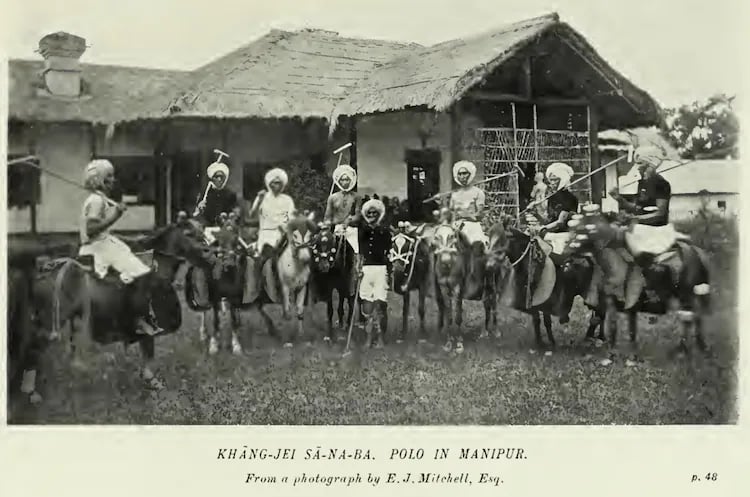
Imphal: There are inheritances a people carry not in books, but in breath and bone. The Manipuri pony is one such inheritance—small in stature, immense in history. It is from these wiry, resilient creatures that the modern game of polo rode out into the world. And yet today, the very animal that gave Manipur a place in global sporting memory stands on the edge of silence. The tragedy is not merely ecological. It is administrative. It is political. And perhaps most damningly, it is a story of a policy that exists more in declaration than in action.
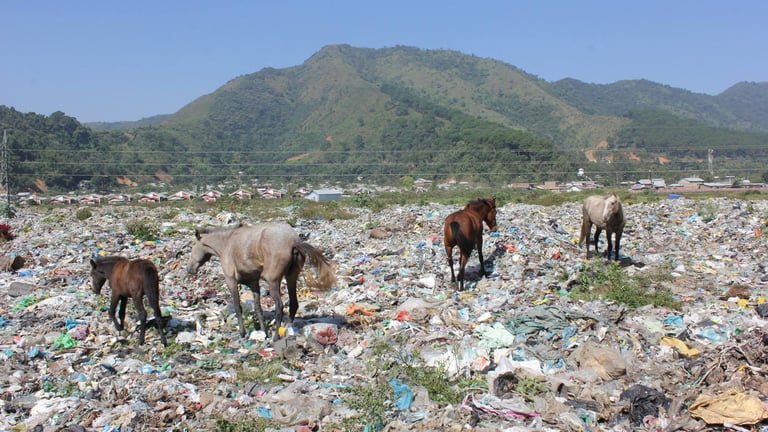
Image: Grazing field turned into city garbage dumping ground in Lamphel Pat.
The Slow Vanishing
Numbers do not lie, but they often fail to stir urgency until it is too late.
From 1,893 ponies in 2003 to 1,083 in 2019, the decline has been neither sudden nor mysterious. It has been gradual, visible, and repeatedly documented. The anticipated figures from the 21st Livestock Census of 2025—yet to be officially released—are expected to hover around 1,150 at best. In the language of conservation science, this is not decline; it is collapse in slow motion.
Maisnam Khellendro, advisor to the All Manipur Polo Association, speaks with the clarity of someone who has watched this erosion over decades. A species, he reminds, becomes endangered when its population dips below 10,000. By that measure, the Manipuri pony was already in danger long before the state formally acknowledged it in 2013.
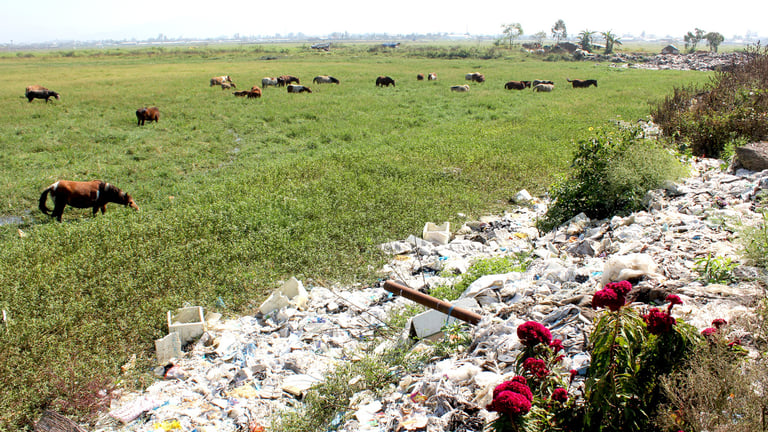
Image: Manipur Polo Ponies grazing field in Lamphel Pat in Imphal,encroached by city garbage.
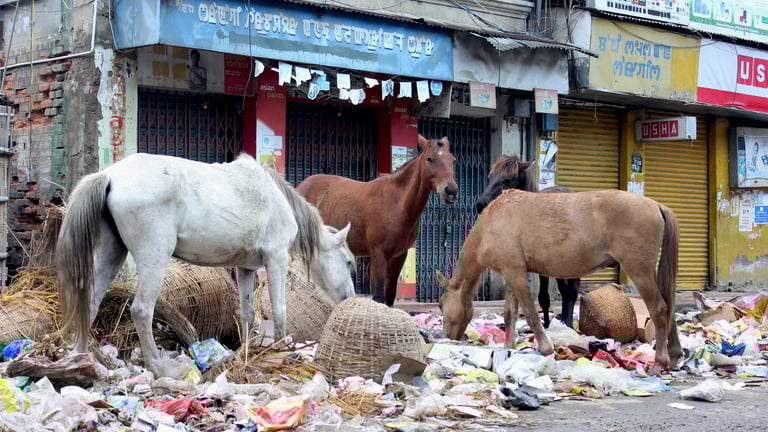
Image: Manipur Polo Ponies feed on city garbage.
That delay matters. Conservation, like medicine, loses its potency when applied late.
Even more unsettling is the composition of the remaining population. Of an estimated 1,150 ponies, barely 150 may be fit for polo—the very cultural practice that justifies much of the state’s conservation rhetoric. The animal survives, but its purpose, its cultural ecosystem, is thinning out.
The Promise of Policy
The Manipur Polo and Pony Preservation Policy, 2016, was meant to turn the tide. It arrived with the language of urgency and the promise of structured intervention—habitat protection, financial incentives, breeding programs, and scientific monitoring.
Among its tools, GPS tagging stood out as a modern instrument for an old problem. Tagging would allow authorities to track pony movements, understand grazing patterns, prevent theft, and build a reliable database for long-term planning. It was, in principle, a simple but powerful step: to first know the animal before attempting to save it.
Years later, that promise remains largely unfulfilled.
The state’s recent assertion that GPS tagging is being implemented does not signal progress—it exposes delay. For a policy announced nearly a decade ago, the initiation of such a basic measure today raises uncomfortable questions. Why did it take this long? And if this is the pace of the most straightforward intervention, what of the more complex ones?
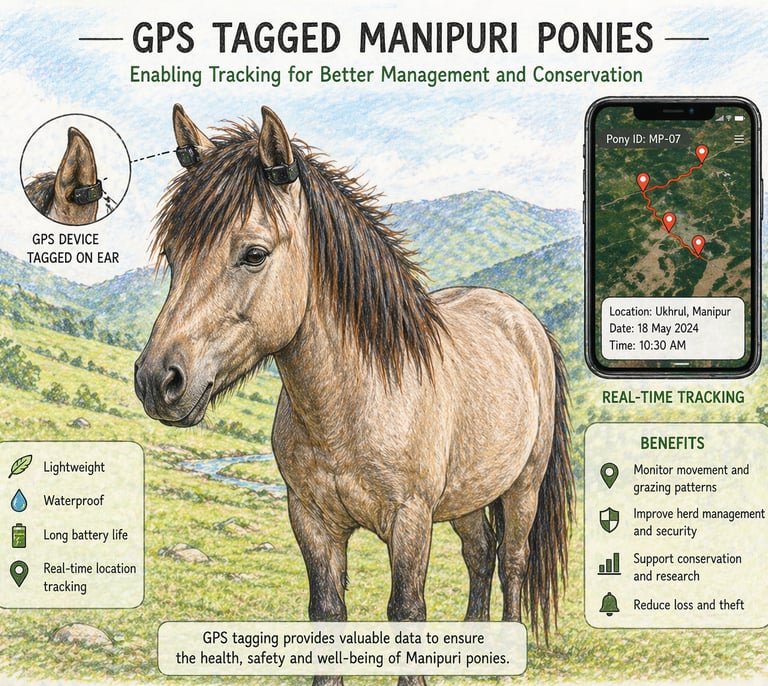
Image:Representative Image of GPS tagged Manipuri Pony
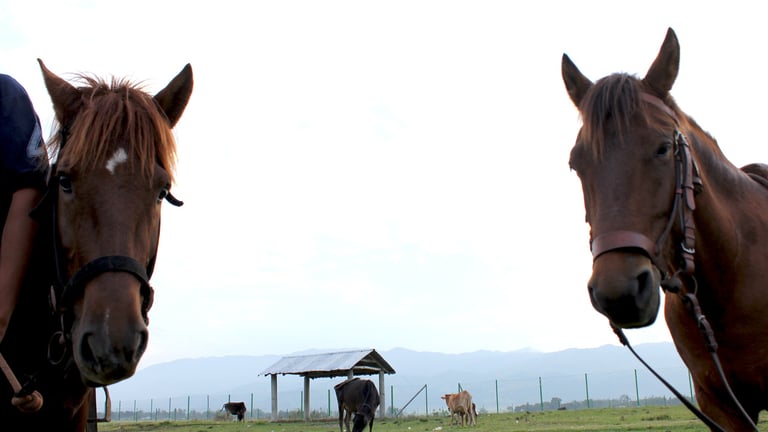
Image:Manipuri Ponies look to the people for help
The Illusion of Implementation
The official narrative suggests movement. The Directorate of Veterinary and Animal Husbandry claims that GPS microchips are ready, that online registration is nearing completion, and that a statewide exercise will soon be underway using 33 Mobile Veterinary Units.
But beneath this surface, contradictions emerge.
While the department asserts that registration is “90% complete,” both Cube10, the private IT firm tasked with designing the system, and the National Informatics Centre (NIC), Manipur, indicate that the software is still in its early stages. Two parallel systems appear to be in development, with little clarity on integration or coordination.
This is not merely bureaucratic confusion—it is symptomatic of a deeper malaise. Conservation cannot function on fragmented systems and conflicting claims. Data integrity is the backbone of any ecological intervention. If the very process of identifying and registering ponies is uncertain, the entire edifice of GPS tracking risks becoming a hollow exercise.
What emerges, then, is not a picture of committed governance, but of procedural drift.
Incentives That Do Not Sustain
Behind every pony stands an owner, and behind most owners stands hardship.
The state’s financial support—₹1,000 per pony per year, later adjusted to ₹2,600 covering nearly two years—is not just insufficient; it is symbolic to the point of irrelevance. A pony, weighing around 300 kilograms, requires consistent nutrition. With natural grazing grounds disappearing, owners are forced to rely on expensive market feed.
Most of these rearers belong to economically vulnerable communities. When the cost of keeping a pony exceeds the means of survival, sentiment alone cannot sustain tradition.
Chongtham Ajit Singh, who owns 30 ponies, lays it bare. Incentives must not only increase—they must be regular. Conservation cannot depend on sporadic disbursements that arrive years apart. When payments lapse, so does trust.
The result is predictable. Owners abandon the practice. And when the keepers leave, the species follows.
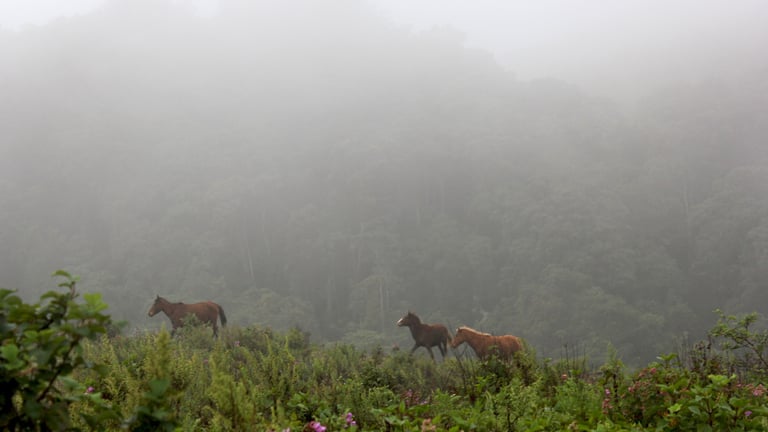
Image:The Semi Wild Manipuri Ponies spotted on the Tingkai Khullen, in Saitu-Gamphazol of Senapati district, where the Government established a Pony Farm but it failed as it wasd not a natural habitat.
The Vanishing Landscape
If policy has faltered in execution, it has failed even more fundamentally in imagination.
The Manipuri pony is not a stable-bound animal. It is semi-wild, shaped by wetlands and open grazing fields. From May to August, these ponies traditionally roam free, feeding on the grasses of Lamphel Pat, Yaral Pat, Sana Pat, and Ekop Pat.
But these landscapes have shrunk—some dramatically. Encroachment, urban expansion, and poorly planned development have reduced both the size and ecological quality of these wetlands. Grasslands have given way to construction. Water bodies have receded or degraded.
Today, ponies are increasingly seen not in fields, but on roadsides and garbage dumps, feeding on plastic and waste. It is a cruel inversion: an animal once central to royal courts and warfare now scavenging for survival.
Dr. Tourangbam Brajakumar, Director of Environment and Climate Change, is blunt. The decline is not environmental—it is social. The land exists, but it has not been protected, reserved, or restored.
Conservation, in this sense, is not about creating new systems but restoring old ones. The failure lies in not recognising this in time.
Misplaced Efforts, Misidentified Spaces
Even where the government has attempted intervention—through breeding farms and grazing reserves—the results have been underwhelming.
The reason is almost elementary: wrong site selection.
Ponies are creatures of the plains and wetlands. Yet, breeding farms have been set up in hilly terrains such as Tinkai Khunou and Heingang. These locations are ecologically unsuitable, undermining the very objective of conservation.
Such decisions point to a top-down approach, where expertise and stakeholder knowledge are sidelined. Khellendro’s insistence on multi-departmental consultation is not a procedural suggestion—it is a necessity. Conservation cannot be dictated; it must be informed.
GPS Tagging: Tool or Token?
In this broader context, GPS tagging risks becoming a token gesture—a visible action that masks deeper inaction.
Yes, tagging can provide valuable data. It can map movement patterns, identify critical habitats, and enable better management. But it is not a solution in itself.

Without adequate grazing land, what will the data reveal except constrained movement? Without financial support, how will owners sustain the animals being tracked? Without habitat restoration, what exactly is being conserved?Technology, when divorced from ground realities, becomes ornamental. The delayed rollout of GPS tagging thus becomes emblematic—not of progress, but of misplaced priorities. It is easier to tag a pony than to secure 100 acres of grazing land in each valley district. Easier to announce a system than to ensure its integrity.
Culture at the Edge
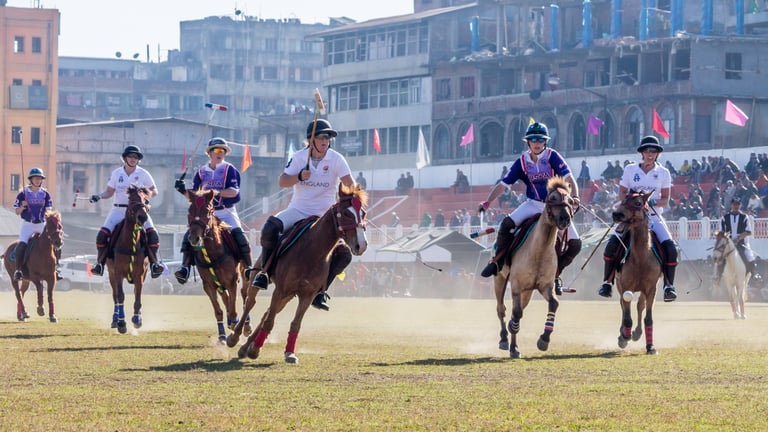
The crisis of the Manipuri pony is not an isolated ecological issue. It is tied to the fate of polo, of traditional sports, of a way of life. Historically, ponies were integral to daily existence—transport, warfare, ceremony, and sport. Under King Khagemba in the 16th century, polo was played among community groups, embedding the animal deeply into social fabric.
Today, that fabric is fraying. With declining pony numbers, the future of polo in Manipur itself becomes uncertain. International participation, once a matter of pride, now hangs by a thread. A culture that once exported a sport to the world struggles to sustain its own playing stock.
What Must Be Done
The path forward is neither obscure nor unattainable. It requires, above all, a return to fundamentals.
First, habitat restoration must take precedence. Wetlands need protection, rejuvenation, and legal safeguarding. Grazing reserves—no less than 100 acres per valley district, as suggested—must be demarcated and enforced.
Second, financial incentives must be realistic and reliable. Conservation cannot survive on token amounts. If the state values the pony as heritage, it must invest accordingly.
Third, policy implementation must be unified and transparent. A single, functional system for registration and tracking is essential. Conflicting claims and parallel developments erode credibility.
Fourth, conservation must be participatory. Owners, players, associations, and experts must be part of decision-making. The knowledge exists; it must be respected.
Finally, cultural integration is key. Introducing horse riding in schools, promoting equestrian tourism, supporting women riders, and expanding polo infrastructure can create a living ecosystem around the pony.
The Measure of Commitment
In the end, the story of the Manipuri pony is a test—of governance, of cultural memory, and of will.
Policies can be written in neat lines. Announcements can be made with ceremony. GPS tags can be fixed onto animals.
But conservation is not built on declarations. It is built on consistency, on listening, on doing the unglamorous work of restoring land, supporting people, and staying the course.
Right now, the state stands at a delicate threshold. The pony has not vanished. The numbers, though small, still breathe. There is time—but not much.
If this moment passes, history will not be kind. It will remember not the policy that was drafted, but the species that was lost while the paperwork remained in motion.
And somewhere, in the silence that follows, the faint echo of hooves on the polo ground will remind us of what was allowed to fade.
CONTACT
Waari Singbul Office
Konung Mamang
Imphal – 795001
© Copyright 2023 Waarisingbul.com. All Rights Reserved