
Biometrics at the Border: India’s Quiet Reckoning with Migration from Myanmar and Bangladesh
MIGRATION
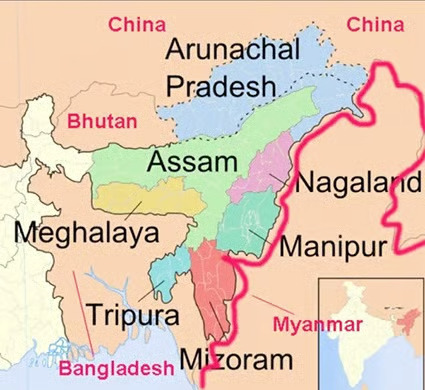
Imphal: By any measure, India’s eastern frontier has never been a mere line scratched across a surveyor’s map. Along the hills and forests binding Assam, Meghalaya, Tripura, Arunachal Pradesh, Nagaland, Manipur, and Mizoram to Bangladesh and Myanmar, kinship has long travelled more freely than law. Colonial cartography split tribes but not memory. Language, faith, and bloodlines ignored customs posts.
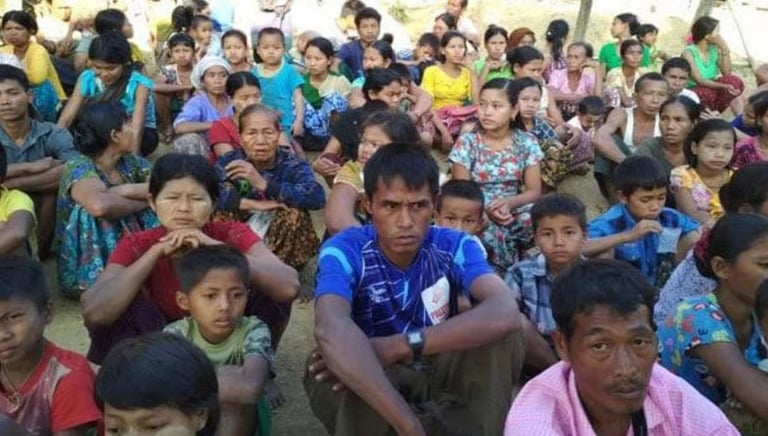
History, however, does not pause for sentiment. When Myanmar’s military overthrew the elected government in February 2021, plunging the country into armed confrontation between the junta and pro-democracy forces, the tremors reached the borderlands. From Chin State, families moved through jungle tracks into India. Young men slipped across ridges. Mothers carried infants through rain and uncertainty. What began as a humanitarian trickle steadied into a sustained flow.
New Delhi now finds itself balancing three hard truths: humanitarian instinct, national security, and the delicate demographic equilibrium of its northeastern states. The instrument chosen to reconcile these competing pressures is not dramatic. It is procedural, digital, and deliberate — compulsory biometric registration.
The coup in Myanmar fractured civil order, particularly in Chin State, where ethnic ties connect communities across the frontier with the Mizo and Kuki-Zo populations in India. Mizoram responded first with cultural affinity rather than calculation. State leaders described the displaced as “our kins.” Relief camps were opened. Civil society mobilised. Churches extended support.
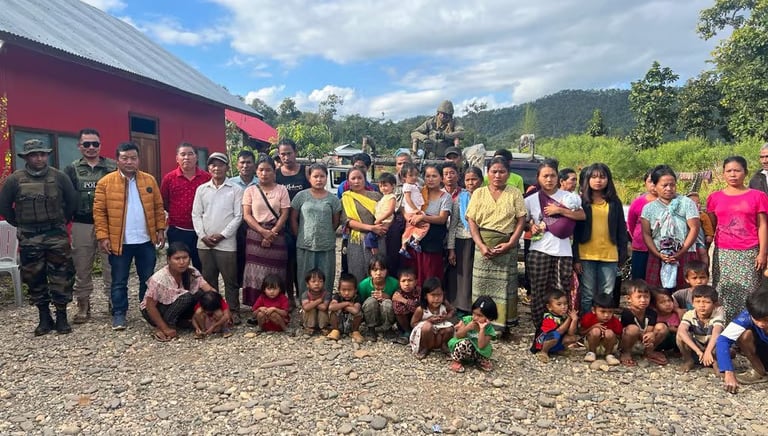
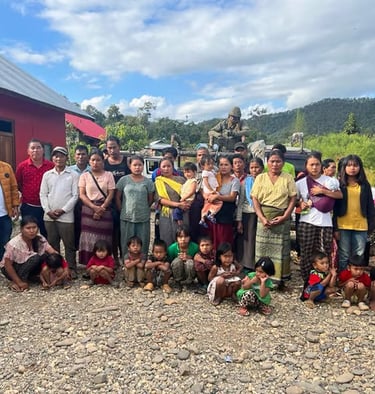
The Union government viewed the developments through a wider strategic lens. India has no codified national refugee law; foreign entrants are regulated under the Foreigners Act. The Centre cautioned against unchecked inflows, citing security risks and demographic sensitivities. The divergence between Aizawl and New Delhi was evident but contained. Compassion operated alongside caution.
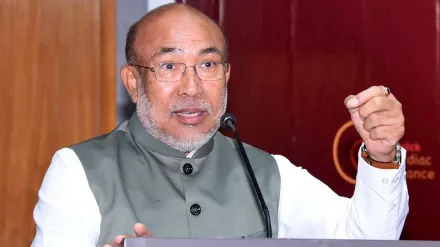
In Manipur, the tone differed markedly. Under former Chief Minister N. Biren Singh, the state pressed for fencing the porous Indo-Myanmar border and tightening the Free Movement Regime. Officials argued that unregulated crossings were not solely humanitarian concerns but potential security vulnerabilities. In a state layered with ethnic complexity, demographic change carries combustible weight.
It was in this climate that the Ministry of Home Affairs directed compulsory biometric enrolment of displaced persons and “illegal migrants” from Myanmar and Bangladesh through a Foreigners Identification Portal and a dedicated Biometric Enrolment System. The logic was austere: establish identity, prevent duplication and impersonation, and create a verifiable digital trail for regulation, aid management, or deportation. Implementation, however, has unfolded unevenly.
Mizoram currently shelters roughly 30,900 Myanmar nationals. Of these, over 27,810 — nearly ninety percent — have undergone biometric registration. Champhai district, bordering Myanmar, has emerged as a frontrunner, completing enrolment for over 12,000 refugees even as new arrivals continue. Hnahthial district has crossed ninety-five percent coverage, while Lawngtlai trails at around seventy-three percent. Technical glitches, mountainous terrain and patchy connectivity slowed the process in several districts earlier this year.
Simultaneously, Mizoram has begun enrolling Bangladeshi Bawm refugees, though progress there remains modest, with only a fraction of the 2,375 individuals registered so far. The state’s evolution from open embrace to systematic enumeration reflects not a retreat from compassion but an acknowledgment that governance cannot operate on sentiment alone. Fresh arrivals — dozens at a time — ensure that documentation must constantly catch up with movement.
If Mizoram’s challenge is administrative management, Manipur’s is layered with consequence. The state has detected 5,457 illegal immigrants, of whom 5,173 have had biometric data recorded. Deportation processes have reportedly commenced in select cases. In Chandel district alone, hundreds were identified this year.
Manipur’s biometric exercise has progressed in stages. Initially, fingerprints were captured manually on paper and later uploaded, a cumbersome process prone to delay and mismatch. The next phase introduced handheld digital devices capable of real-time uploads to central databases. Chandel became the testing ground. Police, immigration officials and Assam Rifles personnel were trained to operate scanners that capture fingerprints and facial recognition data and transmit them directly to the Ministry’s portal. The system cross-verifies identities against national records and relevant international alerts, reducing duplication and strengthening screening for criminal or insurgent links.
The model is now being expanded to Tengnoupal and Ukhrul, forming a digital arc across Manipur’s 390-kilometre frontier. The ambition is plain: monitor what cannot be physically sealed in every kilometre of forested hill.
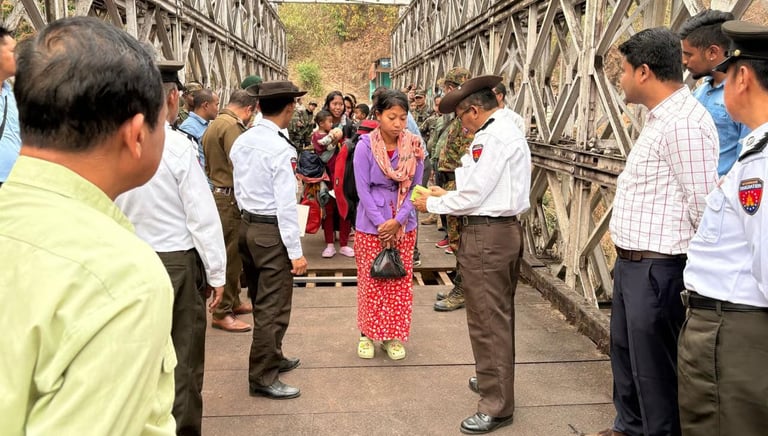
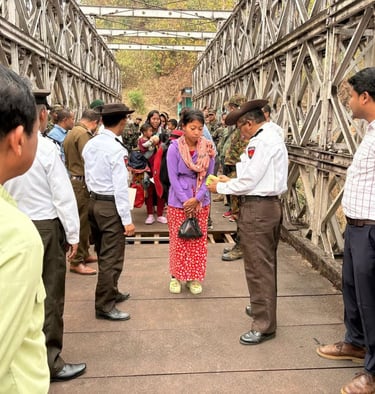
Yet Manipur has not achieved full saturation. Geography remains unforgiving; informal jungle routes continue to facilitate crossings. Arrivals persist intermittently as unrest in Myanmar drags on, making registration a moving target. Administrative capacity in border districts is stretched by manpower shortages, equipment failures and connectivity gaps. Above all, the biometric drive unfolds within a politically charged environment. In Manipur, demographic anxieties are tightly bound to identity politics. Sections of civil society interpret enforcement through the prism of survival.
The violence that convulsed Manipur in 2023 has been examined through ethnic and political frameworks, but migration — real and perceived — entered public discourse as a flashpoint. Allegations of demographic imbalance, forest encroachment and undocumented settlements deepened distrust. It would be simplistic to attribute unrest solely to migration; it would be naïve to ignore its psychological impact. In small states, numbers are not abstractions. A few thousand can shift local equations. In this context, biometric registration serves not merely as bureaucratic routine but as symbolic reassurance that the state is counting rather than guessing.
Critics, including advocacy groups abroad, have characterised aspects of enforcement as heavy-handed. State authorities counter that the protection of indigenous communities demands vigilance, pointing to stringent immigration regimes in Western democracies. The tension between enforcement and empathy is undeniable. Real-time biometric uploads could accelerate deportations before legal remedies are exhausted. Yet the absence of documentation invites speculation, rumour and parallel narratives. India’s approach appears to seek a middle path: identify first, decide later.
The success of this strategy will depend on sustained registration that adapts to new arrivals, clear procedural guidelines on detention and deportation, and investment in border infrastructure and coordinated patrols. Technology alone cannot resolve migration driven by war, nor can fencing alone manage a frontier shaped by kinship and terrain.
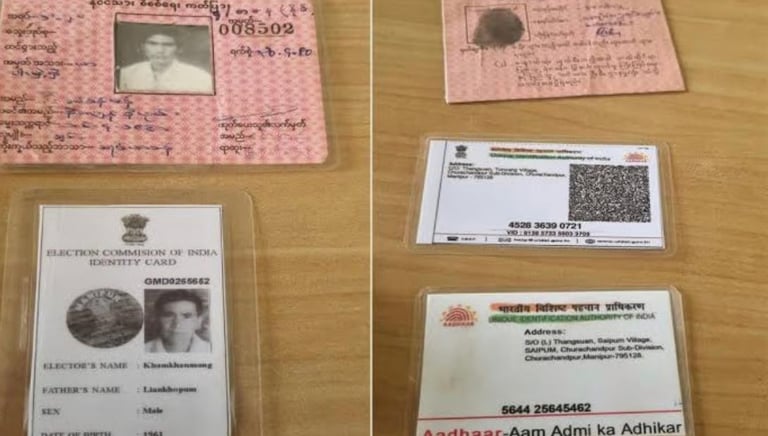
In the Northeast, history often moves in whispers before it erupts in headlines. The quiet hum of biometric scanners in district offices may seem mundane, yet it marks a shift from reactive policing to data-driven governance. Mizoram’s transition from instinctive shelter to structured enumeration reflects administrative maturation. Manipur’s assertiveness reveals a state shaped by vulnerability and recent trauma.
Between compassion and control stands documentation. Between kinship and sovereignty stands the state. India’s task is not to choose one over the other, but to hold both firmly and fairly — without illusion, and without surrendering either its humanity or its authority.
CONTACT
Waari Singbul Office
Konung Mamang
Imphal – 795001
© Copyright 2023 Waarisingbul.com. All Rights Reserved