
Border Fire in Kamjong: Cross-Border Militancy, Strategic Faultlines, and the Deepening Crisis in Manipur
CONFLICT
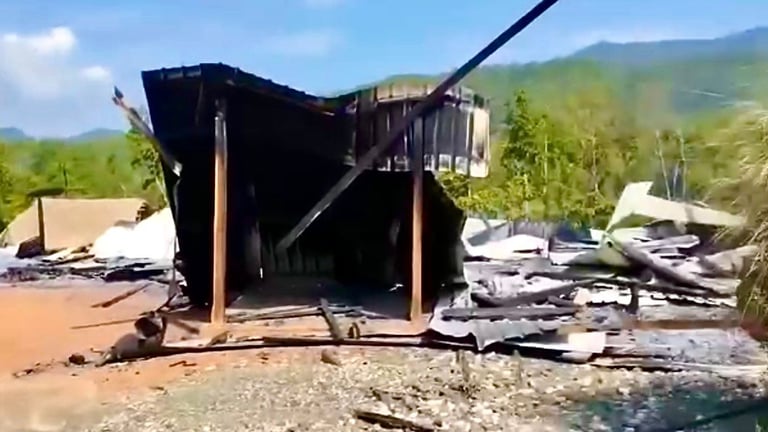
Imphal: The fragile peace along the Indo-Myanmar frontier suffered another grave rupture on 7 May 2026, when heavily armed militants allegedly crossing over from Myanmar launched coordinated attacks on border villages in Manipur’s Kamjong district, setting houses ablaze, injuring civilians, and forcing terrified villagers to flee into forests for safety.The incident, occurring barely days after Manipur marked the third anniversary of the violence that erupted on 3 May 2023, has once again exposed the dangerous convergence of ethnic conflict, insurgent politics, cross-border militancy, demographic anxieties, and geopolitical uncertainty shaping the border state.
Image: Myanmar-based Kuki National Army-Burma (KNA-B) torched the Choro village in Manipur
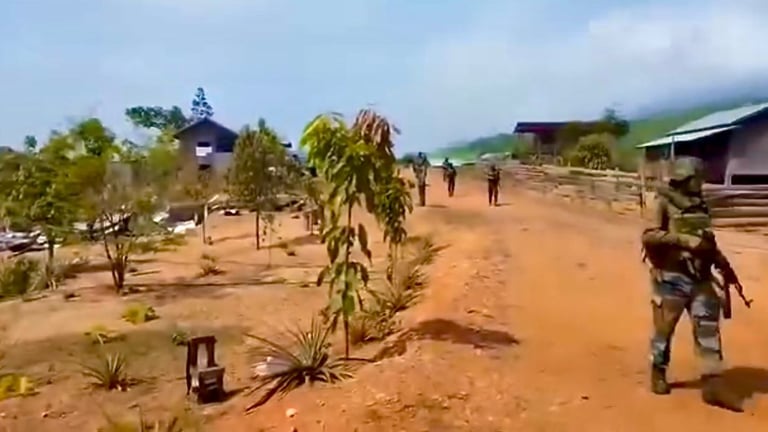
Image: Indian Security inspects the aftermath of Choro village after it was attacked by Myanmar rebel KNA (B)
What unfolded in Kamjong was not merely another isolated act of violence. It was a warning from the frontier.
According to reports emerging from the ground, the attacks took place during the early hours of Thursday in villages including Namlee, Wanglee, Choro, and adjoining settlements under Kasom Khullen subdivision, close to the Indo-Myanmar border. Residents alleged that nearly one hundred armed cadres linked to the Myanmar-based Kuki National Army-Burma (KNA-B) crossed into Indian territory and carried out a pre-dawn assault using automatic weapons before torching houses.
Several homes were reduced to ashes while villagers escaped into nearby jungles amid panic and gunfire. One elderly woman reportedly sustained bullet injuries while attempting to flee. Local organisations and civil society bodies in the Tangkhul-dominated region described the attack as “external aggression” originating from across the international border.
For those living in the eastern hill districts, however, the incident came less as a shock and more as the culmination of fears that had been building for months.
Kamjong district occupies one of the most sensitive stretches of the Indo-Myanmar frontier. Thick forests, difficult mountainous terrain, scattered settlements, and limited surveillance infrastructure have historically made the border highly porous. Communities living on both sides share ethnic and familial ties stretching back generations, long moving across the frontier under the erstwhile Free Movement Regime (FMR).
But the same routes have also been exploited by insurgent organisations, narcotics traffickers, arms smugglers, and undocumented migrants.
The collapse of political order in Myanmar after the 2021 military coup fundamentally altered the security landscape of the region. As Myanmar descended into civil war between the junta and resistance forces, vast territories adjoining India slipped beyond effective state control. Ethnic militias, People’s Defence Forces (PDFs), insurgent groups, and armed networks began operating with increasing freedom close to the Indian frontier.
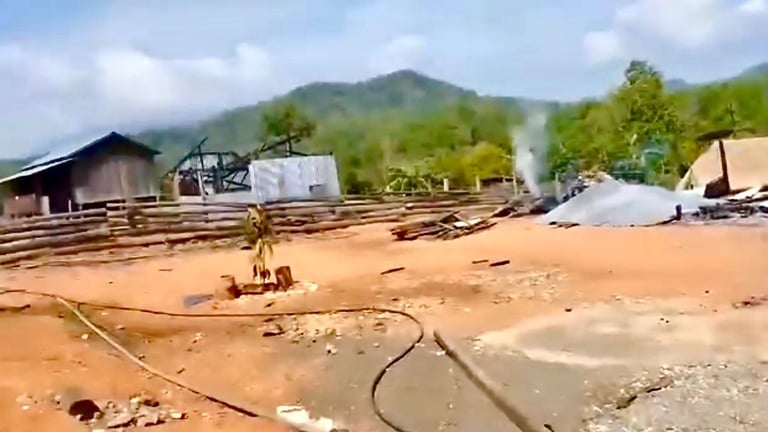
Image:Remains of Choro village in Manipur after Myanmar-based Kuki National Army-Burma (KNA-B) crossed into Indian territory and carried out a pre-dawn assault using automatic weapons before torching houses.
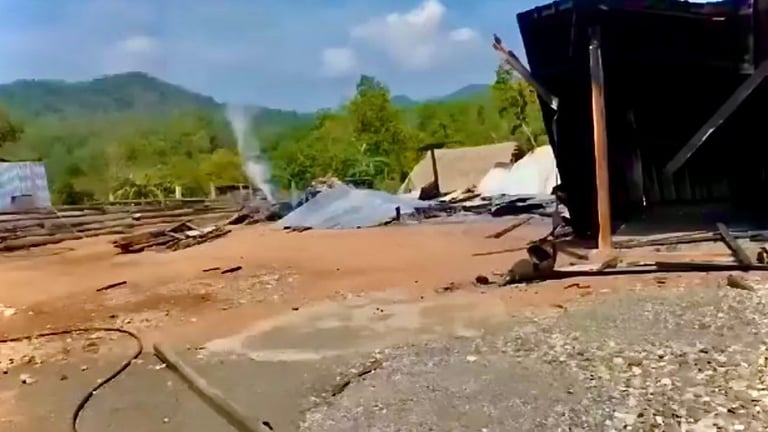
Image:Remains of Choro after Myanmar-based Kuki National Army-Burma (KNA-B) attacked the village
In many ways, Myanmar’s instability slowly spilled into Manipur.
Over the past year, intelligence inputs and local reports repeatedly pointed toward rising militant movement along the Kamjong-Chandel belt. Villagers often spoke quietly of armed cadres moving through forest corridors at night, while occasional gunfire echoing from across the border became an unsettling reminder that the conflict in Myanmar was no longer geographically distant.
The attack on 7 May shattered whatever illusion remained that the violence across the frontier could be contained outside Indian territory.
Yet the significance of Kamjong lies not only in cross-border militancy. The district sits at the centre of another deeply sensitive political geography—that of the Tangkhul Nagas.
Kamjong and neighbouring Ukhrul district form the socio-political heartland of the Tangkhul community, from which the leadership of the NSCN-IM historically emerged, including its influential General Secretary Thuingaleng Muivah. For decades, these eastern hill districts have remained intertwined with the larger Naga political movement.
This is why recent tensions between Naga and Kuki groups in Ukhrul and Kamjong have triggered wider speculation across Manipur’s political landscape.
Increasingly, a section of observers, civil society voices, and political analysts believe that the present instability cannot be understood solely through the prism of ethnic violence. Beneath the surface, they see the familiar architecture of counter-insurgency strategy that has historically shaped India’s management of the Northeast.
For decades, New Delhi’s security doctrine in the region relied not only on military operations but also on balancing rival armed groups through ceasefires, selective accommodation, intelligence penetration, and calibrated political engagement. Insurgent ecosystems were often weakened not merely through direct confrontation, but by fragmenting ethnic and militant solidarities.
It is within this framework that the role of Kuki-Zo armed groups operating under the Suspension of Operations (SoO) agreement has become intensely controversial.
Among sections of Meitei and Naga opinion, there is a growing perception that certain SoO groups have evolved beyond ceasefire entities into strategic counterweights against both Meitei valley insurgents and the Naga insurgent structure led by the NSCN-IM. While such claims remain officially unacknowledged and difficult to conclusively establish, the perception itself has gained strength amid recurring violence in the hill districts.
To many observers, the pattern appears difficult to ignore.
As Manipur’s valley-based insurgencies weakened over the years under sustained security pressure, attention increasingly shifted toward unresolved Naga insurgent structures and the prolonged peace process with the NSCN-IM. Simultaneously, tensions between Kuki and Naga groups in districts such as Ukhrul and Kamjong have become more visible.
Some analysts and local observers now speculate that weakening Tangkhul influence in these eastern hill districts could indirectly erode the operational and political depth of the NSCN-IM in Manipur. In this reading, ethnic fragmentation serves a broader strategic objective: preventing the emergence of unified insurgent influence in the hills while accelerating the long-standing goal of ending insurgency across the Northeast within a defined security framework.
Whether this perception reflects reality or not, it has become politically consequential.
And in conflict zones, perceptions often acquire the force of truth.
For many Meiteis, the Kamjong incident reinforces long-standing fears regarding porous borders, armed infiltration, illegal immigration, and the alleged tolerance shown toward certain armed groups operating under ceasefire arrangements. Among Tangkhul Nagas, the incident has deepened anxieties over the vulnerability of their frontier districts and what they perceive as the gradual weakening of their historical political influence.
Kuki-Zo organisations, however, reject accusations that they function as proxies of the Indian state. They argue that they themselves remain vulnerable amid the ongoing violence and insist that the conflict is rooted in unresolved political aspirations, security fears, and the humanitarian fallout caused by instability in Myanmar.
Yet another layer complicates the crisis further—the issue of illegal immigration.
Since the outbreak of violence in May 2023, concerns over undocumented migration from Myanmar have intensified sharply across Manipur. Sections of Manipuri society, particularly among Meiteis and some indigenous hill communities, believe prolonged cross-border movement has gradually altered demographic balances in sensitive districts over decades. The civil war in Myanmar and the influx of refugees have further amplified these anxieties.
The Government of India eventually announced plans to scrap the Free Movement Regime and initiate border fencing along sections of the Indo-Myanmar frontier. Yet implementation has remained slow, uneven, and politically sensitive.
Resistance emerged not only from tribal organisations within the Northeast but also from actors sympathetic to Myanmar’s anti-junta forces, who viewed fencing and tighter restrictions as disruptive to ethnic ties and humanitarian movement across the frontier.
This is where geopolitics casts its long shadow over Manipur.
India’s approach toward Myanmar has long been shaped by strategic caution. New Delhi requires cooperation from Myanmar’s military establishment to contain Northeast insurgencies and secure strategic connectivity projects under the Act East Policy. At the same time, China’s growing influence inside Myanmar—including infrastructure investments, military engagement, and strategic access to the Bay of Bengal—has made India wary of pushing Myanmar entirely into Beijing’s orbit.
Critics within Manipur increasingly argue that these geopolitical compulsions have contributed to a hesitant and inconsistent border policy, even as instability worsened along the frontier. Many believe India has been reluctant to take decisive action against cross-border militant movement for fear of triggering larger strategic consequences in Myanmar.
The result is a dangerous vacuum.
Three years after the violence of May 2023, Manipur remains deeply fractured. Entire communities continue to live in segregated geographies. Trust between ethnic groups has collapsed. Armed actors retain influence across large stretches of territory. Sophisticated weapons have proliferated. Border districts now exist under the constant fear of sudden incursions and retaliatory violence.
What once appeared to be an internal ethnic conflict is increasingly taking on the characteristics of a frontier crisis shaped by transnational instability.
The Kamjong incident therefore carries implications far beyond a single district.
It signals the growing permeability between Myanmar’s civil war and Manipur’s ethnic conflict. It reveals the dangerous intersection of insurgent realignments, demographic anxieties, and geopolitical calculations. And perhaps most importantly, it exposes the deepening collapse of trust—not only between communities, but between the people and the Indian state itself.
Today in Manipur, every incident is interpreted through layers of suspicion and existential fear. Violence is no longer seen as accidental or isolated. Each attack is read as part of a larger design—ethnic, geopolitical, or strategic.
That may be the most dangerous development of all.
For once a society begins to believe that every fire has an unseen hand behind it, reconciliation becomes infinitely more difficult.
The smoke rising from Kamjong’s burnt villages is therefore more than the aftermath of another border attack. It is the visible sign of a conflict steadily expanding beyond the control of conventional law-and-order responses.
A porous frontier in times of regional instability rarely remains a local problem for long. And today, in the hills of eastern Manipur, the fire from across the border no longer appears distant.
CONTACT
Waari Singbul Office
Konung Mamang
Imphal – 795001
© Copyright 2023 Waarisingbul.com. All Rights Reserved