
India Offers Lifeline to Colombia’s ‘Cocaine Hippos’ as Cull Plan Triggers Global Debate
ENVIRONMENT
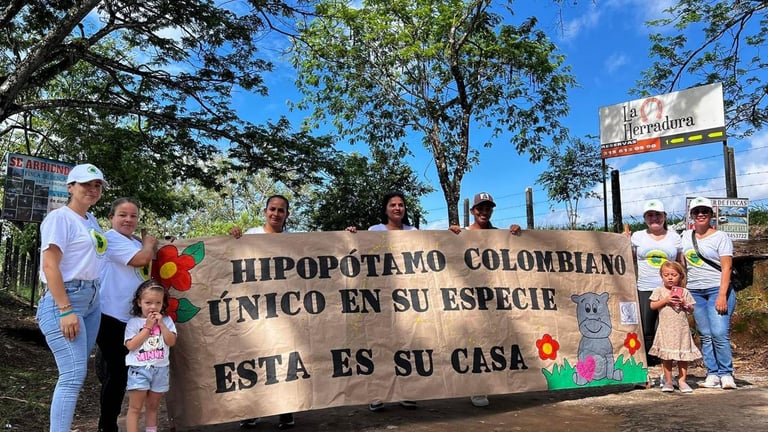
Jamnagar / Bogotá: In a development that has stirred both conscience and caution across conservation circles, Anant Mukesh Ambani, founder of Vantara, has formally urged the government of Colombia to halt the planned killing of 80 free-ranging hippopotamuses in the Magdalena River basin, proposing instead a science-led relocation to India. Ambani is also Executive Director of Reliance Industries.
Image: Activists in Colombia protest against the cull plan - “Colombian hippopotamus — unique in its kind. This is its home.”
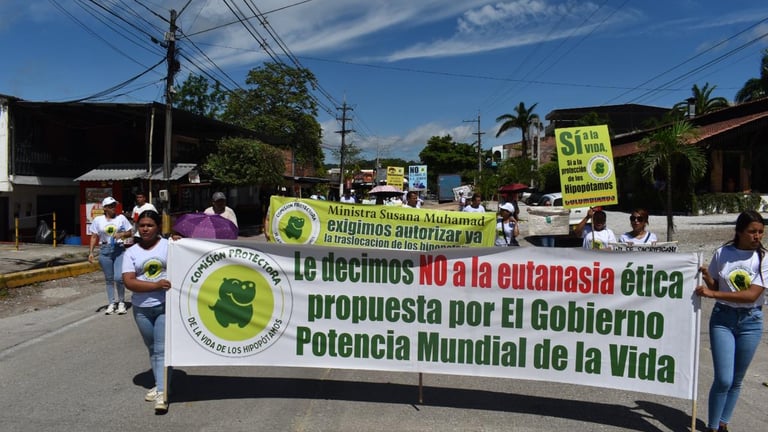
Image: Protestors march with banners - “We say NO to ethical euthanasia proposed by the Government. World Power of Life.”
The proposal, addressed to Environment Minister Irene Vélez Torres, seeks to move the animals—descendants of a small group illegally imported in the 1980s—into the care of Vantara, a sprawling conservation facility in Jamnagar, Gujarat. Backed by the resources of Reliance Industries, the offer includes capture, veterinary supervision, transport, habitat simulation and lifelong care, all under Colombian oversight.
At first glance, the appeal carries the ring of moral clarity. “They did not choose where they were born,” Ambani said, invoking a line that echoes an older ethic—that man, having disturbed the balance, must bear the burden of repair.
Yet the matter is neither simple nor sentimental.
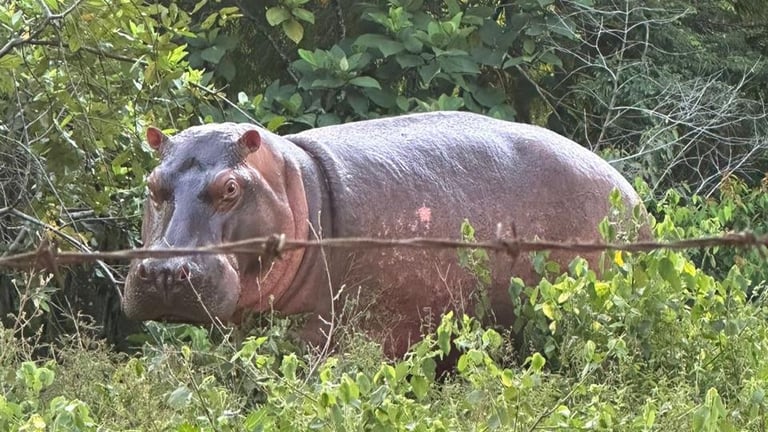
Image: Anant Mukesh Ambani’s Vantara offers a lifeline for the ill-fated Hippo of the Magdalena River basin
A River Out of Balance
The hippos of Colombia—often called “cocaine hippos” owing to their origin in the private zoo of drug lord Pablo Escobar—have, over decades, multiplied unchecked. From a handful, their numbers have swelled to over 150, with projections suggesting a population of more than 400 within the next decade if left unmanaged.
In ecological terms, this is no quiet intrusion. Hippopotamuses are among Africa’s most formidable ecosystem engineers. Transplanted into South America, they alter waterways, compete with native species, and enrich waters with nutrient loads that can trigger algal blooms and degrade aquatic systems. Local communities, too, have begun to feel the strain—crop damage, territorial aggression, and the ever-present risk of human-wildlife conflict.
Colombian authorities, faced with these mounting pressures, have in recent years moved toward control measures, including sterilisation and, now, a sanctioned cull of 80 individuals. It is a decision born less of cruelty than of calculation—a hard arithmetic of ecology.
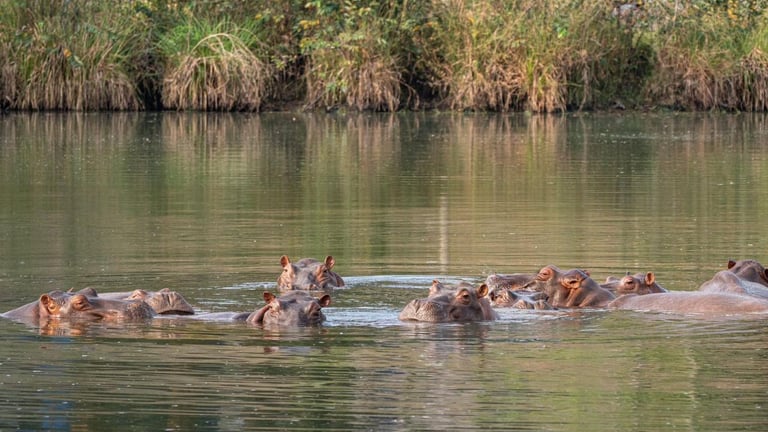
Image: Free-ranging Hippopotamuses in the Magdalena River basin unaware of the fate that awaits them if the planned culling goes ahead.
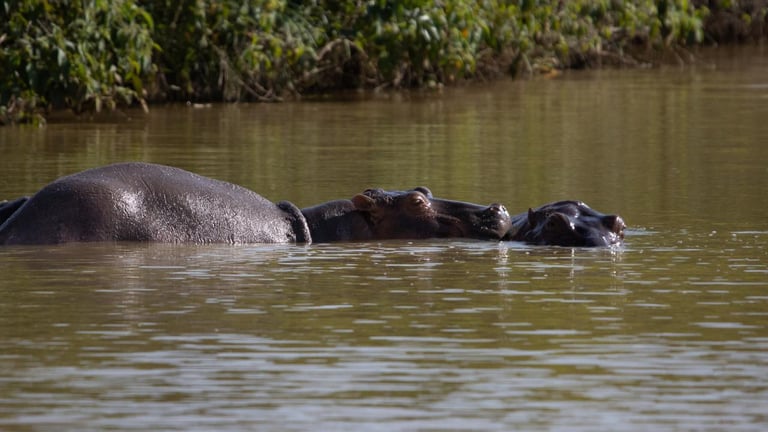
Image: Hippopotamuses the most formidable ecosystem engineers.
Science, Sentiment, and Scale
The intervention proposed by Vantara is ambitious, even unprecedented in scale. Translocating large, semi-aquatic megafauna across continents is a logistical undertaking of rare complexity. Each animal, weighing over a tonne, must be sedated, secured, transported, quarantined, and reintroduced into a carefully designed environment. Mortality risks during such operations are not trivial.
Conservationists remain divided
Some see in the Indian proposal a welcome alternative to lethal control—proof that wealth and will, when aligned, can rescue life from bureaucratic finality. Others caution that relocation, while humane in intent, may not address the ecological imbalance at source. Removing 80 individuals may slow, but not halt, population growth unless accompanied by sustained management measures such as sterilisation.
There is also the question of precedent. If every invasive species crisis were to be solved through transcontinental relocation, would it not merely shift ecological burdens from one geography to another?
India’s Expanding Conservation Footprint
Still, the gesture signals something larger. Facilities like Vantara reflect a growing trend—where private capital steps into spaces once occupied solely by state or multilateral conservation bodies. With vast enclosures, veterinary infrastructure, and a philosophy rooted in rescue and rehabilitation, such institutions are reshaping the grammar of wildlife care.
India, long a custodian of ancient coexistence between man and beast, now finds itself extending that ethic beyond its borders. From elephant corridors to big cat rescues, the country’s conservation narrative is widening—tentative, yet unmistakable.
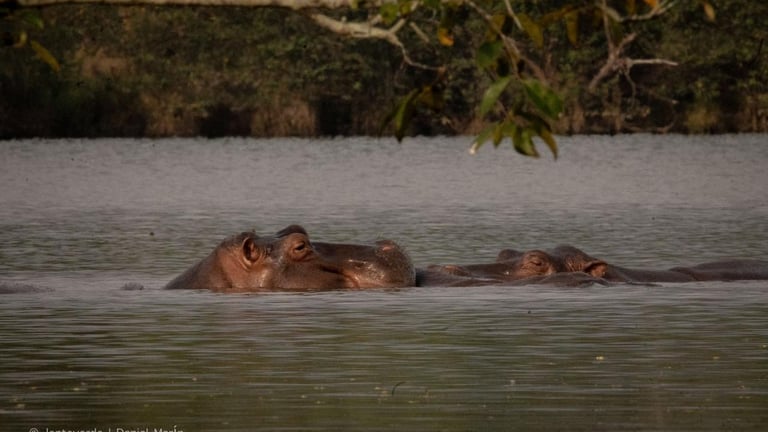
Image: The hippos of Colombia—often called “cocaine hippos” owing to their origin in the private zoo of drug lord Pablo Escobar.
The Road Ahead
For now, the Colombian government has yet to formally respond. Any decision will require not only bilateral agreement but also compliance with international wildlife transport regulations, disease control protocols, and ecological assessments.
Time, however, presses. A cull once authorised carries its own momentum.
In the quiet tension between rifle and rescue lies a familiar truth: conservation is rarely about choosing between right and wrong. More often, it is the uneasy choosing between necessary and possible.
And so, the river waits—its waters carrying not just hippos, but the weight of human judgment.
CONTACT
Waari Singbul Office
Konung Mamang
Imphal – 795001
© Copyright 2023 Waarisingbul.com. All Rights Reserved